
#6 — Through the Prompt Window
Claude Fable, agentic skills, Nolan's Odyssey, Borges' infinite library, and whether AI is ever enough

It's been a minute. I've been busy: new job, lots of updates in A.I, new goals. But I'm back! Writing for the internet can feel like an echo chamber, but it exercises the parts of my brain that bypass looking into a prompt window. And that can only be a good thing.
✽ ✽ ✽
Claude Fable has arrived, and its ability to reason through complex, large coding problems has blown me away. It really eats tokens, though, which is what sent me to Simon Willison's notes on delegating to subagents with judgement. That pushed me to build a
/delegateskill as part of a new skills project I've been working on:product-engineering-skills. Give it a spin if you want to cut down on token spend, grab the full suite, or just the delegate skill, via skills.sh. Aside: Fable's name also sent me straight back to Fable II on the Xbox 360. What a game.
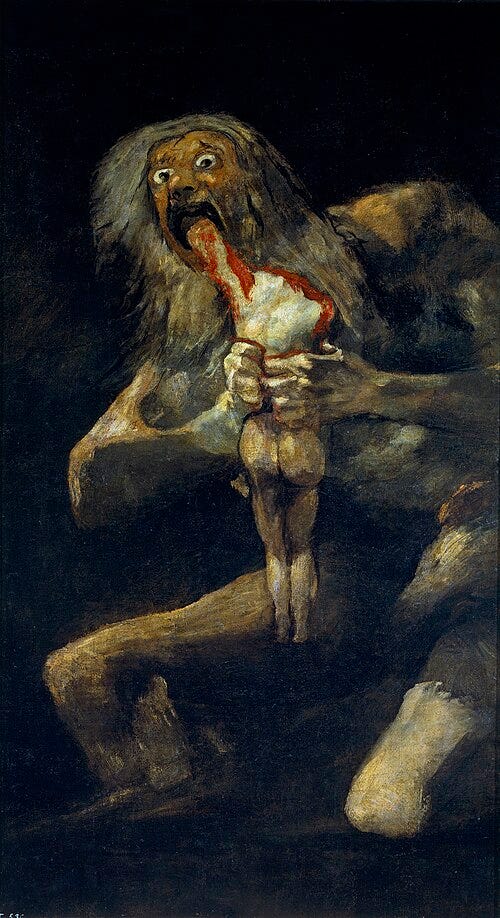
The Odyssey, directed by Christopher Nolan, is excellent. If you haven't seen it, go see it. IMAX, no IMAX, whatever — just see it. The music by Ludwig Göransson is exquisite. I also read that the Cyclops was inspired by Goya's painting Saturn Devouring His Son. Nolan, in his resistance to CGI, often leans on artistic interpretations to draw from; he’s turned to Francis Bacon before, most famously incorporating the thick, smeared impasto of Bacon's paintings into Heath Ledger's Joker makeup for The Dark Knight. Art makes art.
EEG shows brain can simultaneously encode two speech streams (plos.org): “If reading aloud a children story, you may notice you’re able to maintain an independent unrelated train of thought. While doing so, I notice that occasionally extra mistakes can “leak” into the story telling - e.g. you read a single word incorrectly, maybe substituting a word from your other train of thought.” This is super interesting to me in the context of humans’ ability (or lack thereof) to process things in parallel. There’s a classic exercise that demonstrates how much worse we are than computers at parallel processing: try alternating between counting incrementally and reciting the alphabet aloud: “1, A, 2, B, 3, C, 4, D…”. Most people can get to about 4–6 and D–F pretty easily, but then break down. Machines, on the other hand, have no issue with this. Maybe encoding parallel speech streams is the brain’s way of sneaking past its own context-switching bottleneck and doing a kind of parallel processing akin to computers. Try the exercise yourself, first with, and then without the table and see where you break down:

“The modern makers’ machine does not want you to create heavy things [...] Winners of major awards almost always say the same thing as they lift the trophy: ‘Wow! It’s so heavy.’ As though the weight itself validates the achievement. Simple logic: Light achievements beget light awards. Heavy achievements beget heavy awards. We accept this in the physical world. But online, we forget [...] We create more than ever, but it weighs nothing [...] [People] want to make one really, really good thing. One truly heavy thing. A book. A manifesto. A movie. A media company. A monument. — A masterpiece. [...] You ship, but you do not build. You call yourself a creator, but what have you made that could survive a month offline? A year? A decade? If you stopped posting tomorrow, would anything remain? [...] My answer is simple but not easy: Make something heavy.” Very nice.
This is super cool. It's not quite one-shot, but it's the closest thing I've experienced to agentic coding generating animations. My head is already racing with ideas.

I’m reading A Short Stay in Hell by Steven L. Peck, which tells the story of a man trapped in a hell of his own making: an enormous library in which every book is exactly 410 pages long. He’s told there’s a way out, one he shares with everyone else there: to find the book that tells the story of your life.
The premise borrows directly from Jorge Luis Borges’ short story The Library of Babel, and it rhymes with the infinite monkey theorem: the ape that, given enough time at a typewriter, eventually produces Shakespeare.
The catch is that the books are randomly generated. Almost all of them are gibberish:
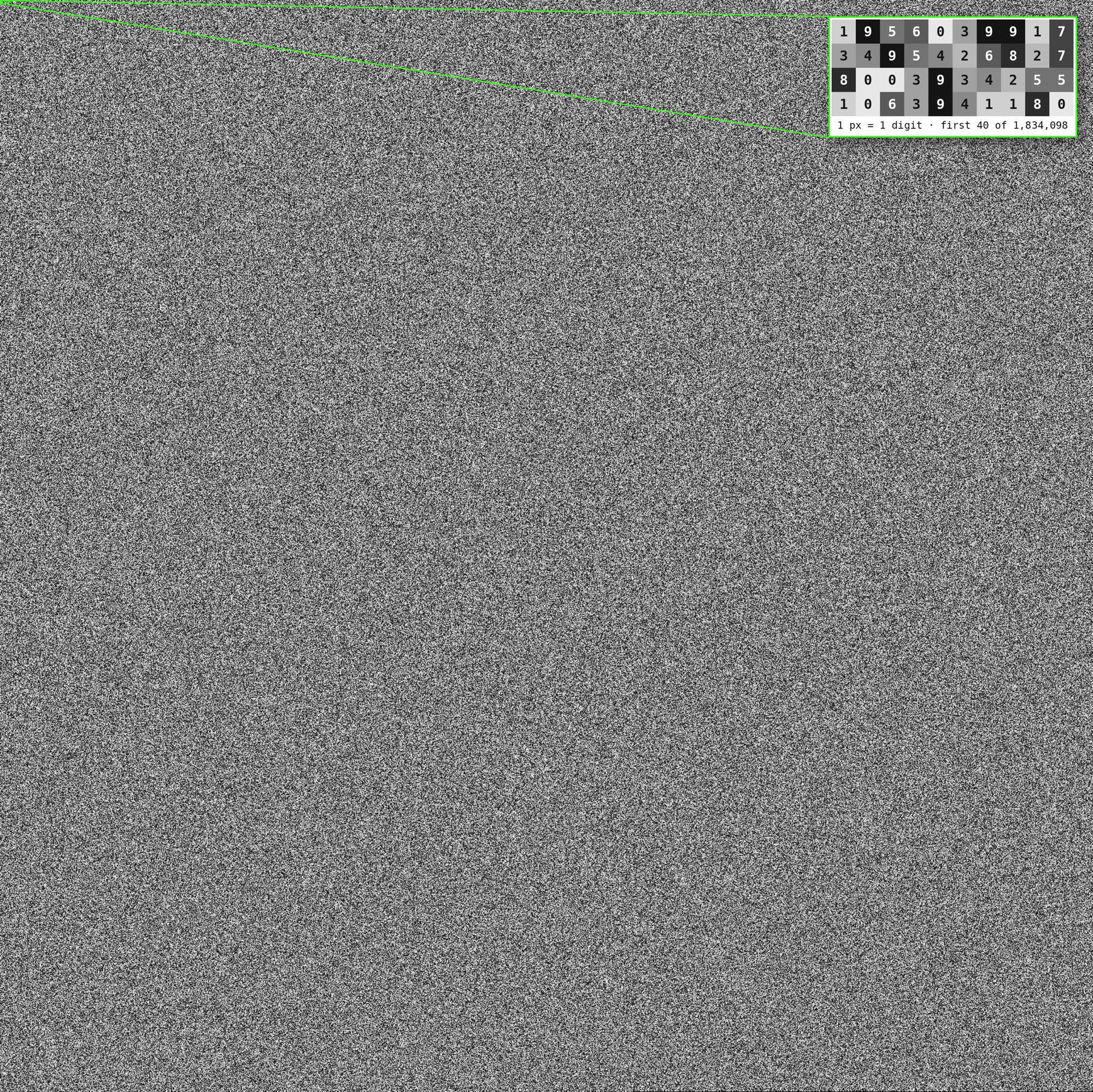
Aj;kLJjppOjnfe7ImNBzuyS@;jHnMBVFghT/.hk, page after page. But hidden in the randomness are books that contain actual words. Somewhere on the shelves is the story of your life told from the perspective of your mother. The story of your life from the perspective of your right hand. The same books again, but told backwards. With the chapters shuffled. With a single misspelling on page 212. None of these count. Only the one true book will do.The characters ponder whether the library is infinite. It isn’t. Borges specifies the format: 410 pages, 40 lines per page, 80 characters per line, drawn from an alphabet of 25 symbols. That works out to 251,312,000 possible books: roughly 101,834,097 . That’s a number nearly two million digits long. For perspective, there are about 1080 atoms in the observable universe. If every atom in the universe were itself an entire universe, and every atom in those universes were a book, you would still have essentially none of the library. The finitude is the torture: the exit exists, it’s countable, and it will take a very, very long time to get out.
Reading it, I kept thinking about Large Language Models. The space of all possible text is the library. LLMs, during training navigate this space, converging on the paths (or corridors in the library) which read as legible. The training set used to train real models (the entire web) is already legible and they use this legibility to help predict the next word given the previous.
If you want to wander the stacks yourself, Jonathan Basile built a working version at libraryofbabel.info. Every page you’ll ever write is already in there.
To put the size of possible books into perspective, I attempted to print the number 101,834,097 below. Each number uses a pixel of different color corresponding to the number.
“Technology was supposed to make room for life but instead for more and more people life is slowly being rearranged around AI. People fear being replaced by machines and respond by giving those machines more of their judgment, attention and time. And for what? Every “saved” hour is returned to a race with no finish line.” I try to maintain a certain level of optimism when it comes to A.I. I really want to believe there's a scenario where it benefits humanity; by allowing people to exercise their creative abilities and human judgment at the things they’re good at, whilst A.I handles the boring stuff. But at times, it feels like we're in a race to stay relevant with the rate of change in A.I (especially in software), and it feels like enough is never enough.
✽ ✽ ✽